Understanding the B2B Sales Funnel Stages: A Complete Guide to Turning Leads into Long-Term Clients
Introduction
When it comes to business-to-business (B2B) sales, every deal starts as a lead, but not every lead becomes a customer. A successful purchase rarely happens by chance, and it’s not as simple as sending a quote and waiting for a "yes." The B2B sales funnel maps out the journey before a final decision is made. It’s a structured process that guides potential buyers from initial awareness to final purchase, helping companies turn interest into measurable revenue.
Unlike business-to-consumer (B2C) funnels, where purchases often happen quickly and emotionally, B2B funnels are longer, more strategic, and relationship-driven. They involve multiple decision-makers, higher-value deals, and more complex buying journeys. Each stage requires specific strategies that nurture trust and provide value over time.
Understanding how this funnel works is critical for sustainable business growth. Without a clear process, leads get lost, opportunities slip away, and revenue becomes unpredictable. A well-defined sales funnel ensures that every lead has a path and every stage has a purpose.
In this blog, you’ll learn how a B2B sales funnel operates, what makes it different from other models, and how to optimize each stage for maximum efficiency. We’ll cover the essential strategies for attracting, qualifying, and converting leads, along with the key metrics to measure your success.
Understanding the B2B Sales Funnel Stages: A Complete Guide to Turning Leads into Long-Term Clients
Why the B2B Sales Funnel Matters
1. Structure for Complex Journeys
2. Bridging Sales and Marketing
3. Building Trust at Every Stage
4. Adapting to Longer Decision Cycles
1. Awareness: Getting on the Radar
2. Interest: Capturing Curiosity
3. Consideration: Evaluating Solutions
4. Intent: Expressing Genuine Buying Signals
5. Evaluation: The Decision Process
7. Retention (and Advocacy): Turning Customers into Champions
The Do's and Don'ts in B2B Sales Funnel Stages
1. Map Out the Entire Buyer Journey
2. Qualify Leads Early and Accurately
3. Align Sales and Marketing Efforts
4. Personalize Every Interaction
5. Focus on Nurturing, Not Just Selling
6. Track, Measure, and Optimize Constantly
DON’TS: Common Mistakes to Avoid
2. Don’t Treat All Leads the Same
3. Don’t Ignore the Power of Follow-Up
4. Don’t Overcomplicate Your Funnel
5. Don’t Rely Entirely on Automation
6. Don’t Forget About Post-Sale Engagement
How B2B Sales Funnel Stages Work for Each Industry
1. SaaS (Software as a Service)
3. Professional Services (Consulting, Marketing, Finance, etc.)
5. Healthcare & Pharmaceutical
Things to Consider During the B2B Sales Funnel Stages
1. Audience Clarity and Segmentation
2. Consistent Messaging and Value Delivery
3. Sales and Marketing Alignment
4. Data-Driven Decision-Making
5. Personalization and Relationship Building
6. Continuous Nurturing Beyond the Sale
How nerDigital.ai Works for B2B Sales Funnel Stages
1. Awareness: Smarter Outreach and Lead Capture
2. Interest: Personalized Nurturing and Content Delivery
3. Consideration: Lead Scoring and Sales Handoff
4. Intent and Evaluation: Sales Enablement Insights
5. Purchase and Retention: Automation Beyond Conversion
Why the B2B Sales Funnel Matters
In B2B sales, deals are different, and that’s exactly why having a structured sales funnel matters. Unlike the fast, emotion-driven purchases in consumer markets, B2B buying journeys are long, layered, and filled with careful evaluation. A funnel brings clarity to that complexity. It maps out every stage of the process, from first touchpoint to final signature, ensuring that every lead is guided with purpose rather than left to chance.
1. Structure for Complex Journeys
A B2B funnel acts like a blueprint for your revenue strategy. Each stage, from awareness, consideration, decision, and retention, helps you understand what your prospects need and how to meet them there. Without it, teams often waste time chasing unqualified leads or skipping crucial nurturing steps. With a funnel, your entire customer journey becomes intentional, measurable, and repeatable.
2. Bridging Sales and Marketing
One of the biggest challenges in B2B is misalignment between marketing and sales. Marketing generates leads; sales closes deals. However, valuable opportunities get lost when they’re not synchronized. A clear funnel keeps both teams on the same page. Marketing knows when to hand over leads, and sales knows exactly how to continue the conversation. It’s the framework that turns teamwork into revenue.
3. Building Trust at Every Stage
B2B buyers rarely make impulsive decisions. They want proof, reassurance, and relationships. A structured funnel supports this by giving you multiple touchpoints to build credibility through case studies, personalized demos, or insightful content. This way, you can earn their trust that lasts beyond one transaction.
4. Adapting to Longer Decision Cycles
In B2C, a purchase might take minutes. In B2B, it can take weeks or months, with several decision-makers involved. The funnel accommodates this reality by tracking engagement, nurturing interest, and providing tailored value at each step. It ensures that even with multiple stakeholders, the process feels seamless and personalized.
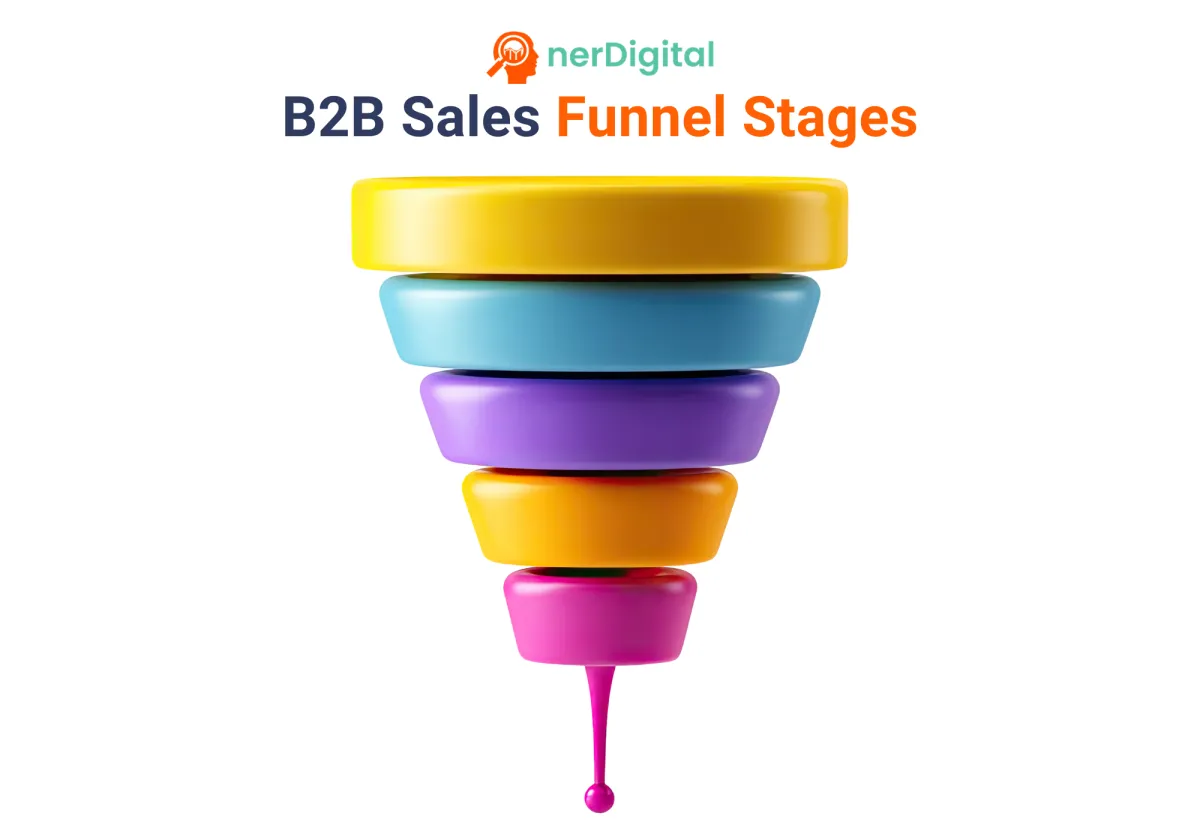
The B2B Sales Funnel Stages
Every successful B2B sale begins long before a contract is signed. It starts with awareness, a simple spark of curiosity, and evolves through trust, education, and validation before it ever becomes a purchase. The B2B sales funnel is the roadmap that defines this journey. Unlike B2C funnels, which are often short and emotionally driven, B2B funnels are strategic, data-informed, and built around relationships that take time to mature.
Below is a detailed look at each stage of the funnel. You'll discover what it represents, what to focus on, and how businesses can optimize it for consistent growth.
1. Awareness: Getting on the Radar
This is where everything begins. At this stage, your potential buyers may not even know they have a problem, or let alone that your product or service could solve it. The goal here isn’t to sell but to educate and create visibility.
Key focus: Reach and brand recognition.
Create thought leadership content like blogs, LinkedIn articles, and industry insights.
Invest in SEO to ensure your brand appears in search results when prospects start researching.
Use social media, webinars, and podcasts to build credibility in your niche.
Awareness is about planting the seed. Even if prospects don’t act immediately, you’re positioning your brand as a trusted authority so when they’re ready to buy, they remember you first.
2. Interest: Capturing Curiosity
Once you’ve caught a prospect’s attention, the next step is to keep it. At the interest stage, buyers are beginning to explore potential solutions. They’re looking for more detailed insights that connect their challenges to what you offer.
Key focus: Engagement and education.
Offer gated content like eBooks, checklists, or webinars that address specific pain points.
Use email nurturing sequences to stay top of mind.
Encourage prospects to subscribe, download, or follow your brand for more insights.
This stage is where you begin transforming cold awareness into warm interest. Every interaction should make prospects feel like they’re learning something valuable and not just being sold to.
3. Consideration: Evaluating Solutions
At this point, your prospects are comparing their options. They know what problem they want to solve and are looking for the best partner to help them solve it. The goal here is to prove that your product or service is the most relevant, reliable, and cost-effective solution.
Key focus: Differentiation and credibility.
Provide detailed case studies, testimonials, and product comparisons.
Host live demos or Q&A sessions to showcase how your solution works in real-life scenarios.
Align your content with specific buyer personas and speak directly to their industry and role.
In the consideration stage, storytelling is powerful. When prospects can see themselves succeeding with your product, they move closer to a buying decision.
4. Intent: Expressing Genuine Buying Signals
This stage is the turning point where curiosity transforms into commitment. Buyers here are actively signaling that they’re ready to take the next step. They might request a proposal, sign up for a free trial, or ask for a custom quote.
Key focus: Reassurance and confidence.
Use targeted follow-ups to address objections or hesitations.
Offer clear next steps such as “Book a consultation” or “Start your free trial.”
Personalize communication. Try to use names, reference past interactions, and highlight relevant benefits.
Intent is fragile; a poor experience or confusing process can derail a deal. Make sure your path from interest to conversion is smooth, supportive, and human.
5. Evaluation: The Decision Process
In B2B, evaluation is rarely a solo decision. Multiple stakeholders, from procurement to executives, often weigh in. Here, buyers scrutinize your offer against competitors, pricing, implementation support, and ROI expectations.
Key focus: Proof and partnership.
Present detailed proposals outlining deliverables, costs, and expected outcomes.
Offer ROI calculators, implementation roadmaps, or success metrics to demonstrate tangible value.
Assign a dedicated sales representative or account manager to guide the process.
At this stage, transparency builds trust. Be open about pricing, realistic about timelines, and proactive in addressing concerns. Businesses that communicate clearly often win not because they’re the cheapest but because they’re the most reliable.
6. Purchase: Sealing the Deal
After careful evaluation, the buyer is ready to commit. This stage is all about ensuring a smooth transition from prospect to customer.
Key focus: Clarity and experience.
Simplify the checkout, contract signing, or onboarding process.
Offer step-by-step guidance to minimize friction.
Celebrate the partnership. You can send a thank-you message or onboarding package that can leave a strong impression.
A well-handled purchase stage reinforces your professionalism and sets the tone for the relationship ahead. Remember, the goal isn’t just to close one deal but to open the door for many more.
7. Retention (and Advocacy): Turning Customers into Champions
The sale might be over, but the relationship is just beginning. In B2B, customer retention is often more valuable than acquisition. Loyal clients not only renew contracts but also become advocates who refer new business.
Key focus: Relationship and loyalty.
Maintain communication through newsletters, updates, and customer check-ins.
Offer exclusive perks, early access to new features, or loyalty discounts.
Encourage feedback and highlight customer success stories across your channels.
When customers feel supported after the sale, they transform into advocates, sharing testimonials, case studies, and referrals that attract new prospects organically.
The Do's and Don'ts in B2B Sales Funnel Stages
The most effective B2B sales funnels are built on clarity, trust, and continuous improvement. If you're dealing with tons of businesses, especially when there are huge prices at stake, small mistakes might cost a lot. When you understand what works and what doesn’t, you create a smoother, smarter buyer journey that benefits both your customers and your bottom line. Here are some do's and don'ts when it comes to B2B sales funnel stages:
DO’S: What to Focus On
1. Map Out the Entire Buyer Journey
Start by clearly defining what each stage of your funnel looks like, from Awareness to Retention. Identify the questions, challenges, and motivations your prospects have at each step. When you know what your audience needs, it becomes easier to craft content, messaging, and outreach that align perfectly with their buying journey.
2. Qualify Leads Early and Accurately
Not every lead is worth pursuing. Use clear qualification criteria to distinguish Marketing Qualified Leads (MQLs) from Sales Qualified Leads (SQLs). The earlier you identify high-intent prospects, the more efficiently you can allocate your sales resources and improve conversion rates.
3. Align Sales and Marketing Efforts
One of the most common causes of funnel inefficiency is poor alignment between marketing and sales teams. Establish shared goals, consistent definitions of lead stages, and real-time data visibility through your CRM. This ensures leads move through the funnel seamlessly and no opportunity falls through the cracks.
4. Personalize Every Interaction
Generic outreach no longer works in B2B sales. Use buyer personas, industry data, and behavioral insights to tailor your communication. From the first touchpoint to the final proposal, every message should feel relevant and specific to the prospect’s pain points.
5. Focus on Nurturing, Not Just Selling
Some leads take weeks or even months to make a decision. Don’t lose momentum after the first conversation. Build long-term trust through follow-ups, educational content, case studies, and consistent engagement across multiple channels.
6. Track, Measure, and Optimize Constantly
Data is the backbone of an effective sales funnel. Measure metrics like conversion rate, deal velocity, and pipeline value at every stage. Regularly review your performance to identify bottlenecks and refine your strategy based on evidence, not assumptions.
DON’TS: Common Mistakes to Avoid
1. Don’t Rush the Process
In B2B sales, patience is essential. Pushing for a close too early often turns warm leads cold. Instead, focus on nurturing relationships and delivering value because the sale will follow naturally when trust is established.
2. Don’t Treat All Leads the Same
Every company, industry, and decision-maker is different. Avoid sending blanket messages or using one-size-fits-all email sequences. Tailor your approach to fit the buyer’s stage in the funnel and their specific business context.
3. Don’t Ignore the Power of Follow-Up
Many deals are lost simply because businesses fail to follow up. A polite check-in, a helpful resource, or a quick update can keep your brand top-of-mind. Persistence with professionalism often separates successful sellers from average ones.
4. Don’t Overcomplicate Your Funnel
Too many steps or unnecessary touchpoints can confuse your team and overwhelm your prospects. Keep your funnel streamlined, with clear progression criteria between each stage. Simplicity leads to consistency and consistency drives conversions.
5. Don’t Rely Entirely on Automation
Automation tools can streamline workflows, but they can’t replace genuine human interaction. Use technology to support your process and not to replace empathy and real conversations. A balance of automation and personalization is what makes a funnel truly effective.
6. Don’t Forget About Post-Sale Engagement
The funnel doesn’t end when the contract is signed. Retaining customers is far more cost-effective than acquiring new ones. Continue nurturing relationships through onboarding, support, and regular check-ins. Happy clients often become repeat buyers and powerful advocates for your brand.
How B2B Sales Funnel Stages Work for Each Industry
Every industry follows the same broad B2B sales funnel stages but how each stage plays out can vary dramatically. The decision-making process, deal length, and buyer expectations all depend on the nature of the business. Understanding these nuances helps you tailor your funnel strategy for higher conversion and stronger customer relationships.
Let’s look at how the B2B sales funnel works across different industries:
1. SaaS (Software as a Service)
In the SaaS world, the funnel is all about demonstrating value early. Buyers want proof that your software will make their lives easier and faster.
Awareness: SEO-driven blogs, explainer videos, and social proof (like reviews) attract potential users.
Interest & Consideration: Free resources, webinars, or feature comparisons help users explore functionality.
Intent & Evaluation: Free trials or live demos play a crucial role here. They let buyers experience the product firsthand while allowing your sales team to personalize support.
Purchase & Retention: Onboarding and regular check-ins ensure customers see continued value which is the key to reducing churn and boosting renewals.
For SaaS, the funnel doesn’t end at conversion; retention and advocacy are where growth really happens.
2. Manufacturing & Industrial
Manufacturing sales cycles are longer, often involving multiple decision-makers and high-value contracts. Trust and technical credibility are everything.
Awareness: Trade shows, industry publications, and LinkedIn campaigns introduce your capabilities to potential clients.
Interest: Detailed spec sheets, certifications, and product demos help demonstrate reliability and compliance.
Consideration & Evaluation: Clients often request proposals or samples, so responsiveness and precision in communication are critical.
Purchase & Retention: Once a partnership begins, post-sale service, consistent supply, and performance updates maintain loyalty.
In this industry, the funnel is about relationship depth more than volume. Each lead represents a long-term business opportunity.
3. Professional Services (Consulting, Marketing, Finance, etc.)
Here, expertise and credibility are the main currencies. Together with buying services, buyers are also purchasing trust.
Awareness: Thought leadership through whitepapers, case studies, and podcasts builds authority.
Interest: Personalized email campaigns and webinars help position your brand as a knowledgeable partner.
Consideration: Clients often evaluate your past work, testimonials, and client portfolio.
Evaluation & Purchase: Clear proposals and transparent pricing make the decision easier.
Retention: Consistent reporting, measurable results, and proactive communication ensure client satisfaction.
For service-based businesses, the funnel focuses on reputation, proof of results, and maintaining strong relationships long after the sale.
4. Technology & IT Solutions
B2B tech companies often deal with highly informed buyers who value technical performance and scalability.
Awareness: Educational content like use-case articles and industry-specific videos attract technical audiences.
Interest: Webinars, case studies, and solution briefs nurture prospects and address technical concerns.
Consideration: Live demos and proof-of-concept trials are crucial.
Evaluation & Purchase: Buyers expect detailed security documentation, ROI projections, and support assurances.
Retention: Continuous product updates and customer success programs build advocacy.
Here, precision and technical expertise are essential because buyers expect clear evidence before committing.
5. Healthcare & Pharmaceutical
In this industry, regulation and compliance make the funnel highly complex and slow-moving.
Awareness: Research publications, conferences, and partnerships establish credibility.
Interest: Educational webinars and data-driven insights demonstrate authority.
Consideration: Stakeholders review certifications, safety data, and case studies.
Evaluation: Procurement and compliance teams assess every detail before purchase.
Retention: Ongoing support and compliance reporting strengthen partnerships.
The healthcare funnel thrives on transparency, ethics, and trust.
Things to Consider During the B2B Sales Funnel Stages
Managing a B2B sales funnel goes beyond simply moving leads from one stage to another. Each stage requires a unique strategy, level of attention, and coordination between marketing and sales. To create a funnel that actually converts, here are the key things to consider at every step.
1. Audience Clarity and Segmentation
Before leads even enter the funnel, define your ideal customer profile (ICP). Understand their pain points, decision-making process, and the triggers that drive purchase intent. In B2B, buying decisions often involve multiple stakeholders, so your content and communication should address technical users, financial buyers, and decision-makers differently. Segmentation ensures you’re nurturing each audience with relevant and timely messages.
2. Consistent Messaging and Value Delivery
From awareness to purchase, every interaction should reinforce your brand’s value. Consistent messaging builds trust and recognition, while inconsistency creates confusion. At the awareness stage, focus on educating prospects about industry challenges. In the consideration and evaluation stages, highlight measurable value — efficiency gains, ROI improvements, or risk reduction. A clear narrative helps leads see why your solution stands apart from competitors.
3. Sales and Marketing Alignment
A successful funnel depends on seamless collaboration between marketing and sales teams. Marketing generates qualified leads through targeted campaigns, while sales provides feedback on lead quality and closes opportunities. Define shared metrics, establish lead-scoring criteria, and ensure both teams agree on when a prospect moves from MQL (Marketing Qualified Lead) to SQL (Sales Qualified Lead). Misalignment at this handoff stage can lead to lost deals and wasted resources.
4. Data-Driven Decision-Making
Track performance metrics across every stage. Key indicators like conversion rates, engagement levels, and average deal cycle time reveal where leads are dropping off and where improvements are needed. Use CRM and analytics tools to visualize the funnel and identify bottlenecks. Data not only helps optimize campaigns but also strengthens forecasting and resource allocation.
5. Personalization and Relationship Building
B2B relationships rely on trust and credibility. Generic outreach rarely works. Tailor content, outreach, and offers to the prospect’s industry, company size, and challenges. Use personalized email sequences, targeted case studies, and value-driven follow-ups to make every interaction meaningful. Decision-makers are more likely to engage when they feel understood rather than sold to.
6. Continuous Nurturing Beyond the Sale
The funnel doesn’t end at purchase because it extends into retention and advocacy. Ongoing support, education, and communication transform customers into long-term partners. Maintain engagement through newsletters, product updates, and success check-ins. Retained customers are easier to upsell and often become referral sources, fueling new opportunities at the top of the funnel.
7. Flexibility and Adaptation
Market conditions, buyer behavior, and technology evolve. Regularly audit and adjust your funnel strategies to stay relevant. Test new messaging, adopt automation tools, and refine workflows based on feedback and performance data.
How nerDigital.ai Works for B2B Sales Funnel Stages
Modern B2B sales funnels are driven by data, automation, and personalization. nerDigital.ai helps businesses streamline every stage of their funnel, from lead generation to post-sale engagement, by combining intelligent automation with analytics. Instead of managing multiple disconnected tools, nerDigital.ai centralizes everything to create a seamless and measurable buyer journey.
1. Awareness: Smarter Outreach and Lead Capture
At the top of the funnel, nerDigital.ai helps businesses attract and capture high-quality leads through automated campaigns. It integrates with websites, landing pages, and social channels to identify visitors, capture contact information, and track engagement. AI-driven segmentation ensures that awareness efforts are focused on the right audience, reducing wasted ad spend and improving lead quality from the very first interaction.
2. Interest: Personalized Nurturing and Content Delivery
Once a lead is captured, nerDigital.ai continues nurturing that interest through automated email sequences, chatbots, and personalized content recommendations. The platform uses behavior-based triggers such as link clicks, page visits, or downloads to send targeted follow-ups that educate and build trust. This approach replaces manual lead nurturing with intelligent automation that keeps prospects engaged without overwhelming them.
3. Consideration: Lead Scoring and Sales Handoff
As prospects move deeper into the funnel, nerDigital.ai applies dynamic lead scoring to evaluate their readiness for sales outreach. Scores are based on engagement history, demographics, and behavioral data. Once a lead meets predefined criteria, it’s automatically handed off to the sales team with complete activity tracking. This ensures that sales representatives spend time only on leads most likely to convert to improve efficiency and shorten the sales cycle.
4. Intent and Evaluation: Sales Enablement Insights
During these crucial decision-making stages, nerDigital.ai provides real-time insights into prospect behavior. Sales teams can see which emails were opened, which pages were visited, and what content resonated most. This data empowers reps to tailor conversations, address objections proactively, and present solutions aligned with the prospect’s needs. The platform also supports proposal tracking and pipeline visibility, helping managers identify where deals stall and how to move them forward.
5. Purchase and Retention: Automation Beyond Conversion
nerDigital.ai doesn’t stop once the deal is closed. It continues to enhance the customer relationship through automated onboarding, post-purchase follow-ups, and satisfaction surveys. These features help reduce churn, increase repeat business, and collect feedback that feeds into future campaigns. The same AI-driven personalization that nurtures prospects before purchase now sustains engagement afterward, turning one-time clients into long-term partners.
6. Analytics and Optimization Across All Stages
Every funnel activity within nerDigital.ai is measurable. The platform tracks performance metrics from open rates and conversion ratios to customer lifetime value, and offers detailed reports and actionable insights. With this data, businesses can identify bottlenecks, refine messaging, and continuously improve their funnel performance.
Conclusion
When it comes to B2B sales, you have to be meticulous and guiding a prospect from first contact to loyal customer isn’t always easy. The B2B journey is full of moving parts, long decision cycles, and multiple voices weighing in on every choice. But that’s exactly why having a clear, well-structured B2B sales funnel matters. It gives you direction, helps your team stay aligned, and turns what could feel like chaos into a predictable, repeatable process for growth.
Each stage, from awareness to retention, plays its own role in building trust and moving the relationship forward. When you focus on solving real problems instead of just selling, you create connections that last beyond a single transaction. When you understand what your buyers need at every step and meet them with genuine value, you build a loyal customers base.
And the best part? You don’t have to do it all manually. With nerDigital.ai, you can automate your lead nurturing, track progress across every stage, and gain insights that keep your funnel flowing smoothly. It’s designed to help businesses like yours build smarter, faster, and more meaningful sales journeys.
Ready to turn your B2B sales funnel into a true growth engine? Start optimizing your strategy today with nerDigital.ai now.
