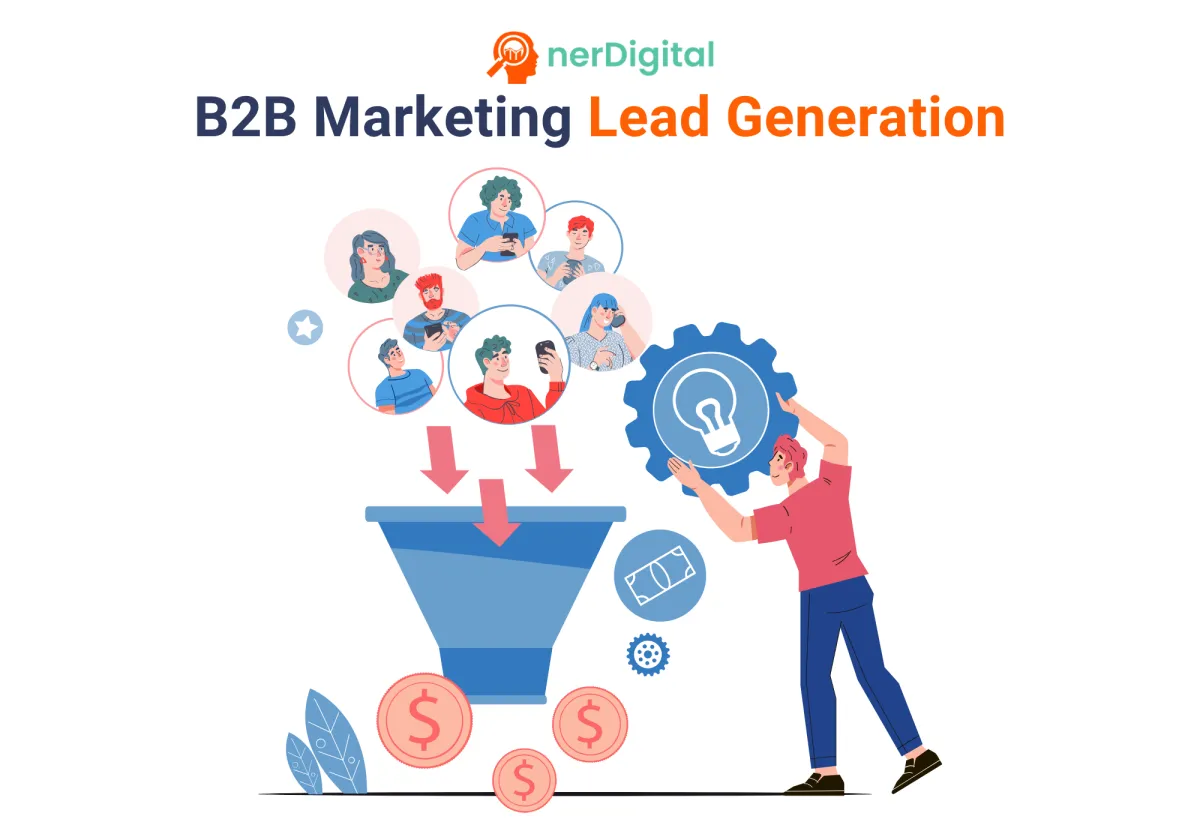
How to Create Meaningful Interactions Through Effective B2B Marketing Lead Generation
Introduction
There was a time when B2B growth depended heavily on who you could reach first. Sales teams relied on cold calls, in-person meetings, and large events to generate interest. It was direct, often unpredictable, and heavily dependent on timing. While those methods still exist, the way buyers approach decisions has changed, and with it, the way lead generation works.
Today, B2B marketing lead generation is the process of identifying and attracting potential customers, then guiding them toward a meaningful interaction. It is no longer just about getting attention. It is about earning it. Businesses focus on reaching decision-makers who are already exploring solutions and providing the information they need to move forward with confidence. At its core, lead generation is about building a pipeline of qualified opportunities that have a real chance of becoming long-term customers.
This process plays a direct role in business growth. Without a consistent flow of new prospects, even the most well-developed products or services struggle to gain traction. Lead generation keeps the pipeline active, supports revenue, and helps businesses stay aligned with real market demand. It ensures that efforts are focused on people who are more likely to engage, rather than casting a wide but ineffective net.
The shift to digital-first behavior has reshaped everything. Buyers now prefer to research on their own, compare options, and gather insights before ever speaking with a sales team. This has led to a stronger focus on inbound strategies, targeted campaigns, and data-informed decisions.
In this article, we will break down how modern B2B lead generation works in practice, and how businesses can build a system that delivers consistent, measurable results.
How to Create Meaningful Interactions Through Effective B2B Marketing Lead Generation
What Is B2B Marketing Lead Generation?
Marketing Qualified Leads (MQLs)
C. Importance of lead quality vs. quantity
Understanding the Target Audience
A. Defining ideal customer profiles (ICPs)
B. Creating detailed buyer personas
C. Mapping pain points and motivations
2. Search engine optimization (SEO)
Content Strategies for B2B Marketing Lead Generation
1. Creating value-driven content
2. Topic selection based on intent
3. Content formats that perform
4. Repurposing and distribution
Nurturing, Qualifying, and Converting B2B Leads
1. Lead Nurturing and Relationship Building
A. Importance of nurturing in B2B
B. Email workflows and drip campaigns
D. Building trust and credibility
2. Lead Qualification and Scoring
A. Defining lead qualification criteria
C. Aligning marketing and sales teams
D. Improving conversion efficiency
Scaling B2B Lead Generation Efforts with nerDigital AI
A. Expanding successful channels
C. Leveraging data and analytics
D. Integrating multiple channels
What Is B2B Marketing Lead Generation?
B2B marketing lead generation is the process of finding and engaging potential buyers, then guiding them toward a point where a business conversation can begin. It is not just about visibility. It is about building interest, capturing intent, and creating opportunities that can realistically turn into revenue.
A. Core concept and process
At its foundation, lead generation follows a simple flow: identify, attract, and capture.
Identifying potential buyers starts with understanding who your ideal customers are. This includes their roles, industries, challenges, and goals. Without this clarity, outreach tends to feel scattered and ineffective.
Attracting interest comes next. This is where marketing efforts take shape through content, campaigns, and channels that bring the right audience in. It could be through search, social platforms, or targeted outreach. The key is relevance.
Capturing leads is the moment interest turns into action. This might happen through form submissions, demo requests, or resource downloads. At this stage, the goal is to make the next step easy and worthwhile.
What makes this process effective is alignment. Each step should feel connected, guiding the prospect naturally from curiosity to consideration.
B. Types of leads
Not all leads are at the same stage of readiness. Understanding the difference helps teams respond more effectively and avoid wasted effort.
Marketing Qualified Leads (MQLs)
These are individuals who have shown interest but are still early in their journey. They may have engaged with content, signed up for updates, or downloaded a guide. Their actions suggest curiosity, but not necessarily immediate intent to buy.
MQLs require nurturing. They benefit from ongoing communication that educates and builds trust over time.
Sales Qualified Leads (SQLs)
These leads are further along. They have demonstrated stronger intent, often through actions like requesting a demo, asking for pricing, or engaging directly with a sales team.
SQLs are ready for a more direct conversation. The focus shifts from education to evaluation and decision-making.
The transition from MQL to SQL is where alignment between marketing and sales becomes critical. Clear criteria help ensure that leads are passed at the right time.
C. Importance of lead quality vs. quantity
It is easy to focus on volume. More leads can feel like progress, but quantity alone does not guarantee results. In fact, a large number of low-quality leads can slow down teams and reduce overall efficiency.
High-quality leads tend to:
Match your ideal customer profile
Show clear signs of intent
Engage with relevant content or offers
These leads are more likely to convert, making them far more valuable than a higher volume of unqualified contacts.
There is also a direct impact on revenue. When lead quality is strong, sales cycles tend to be shorter, conversations are more productive, and conversion rates improve. On the other hand, poor-quality leads often require more time and effort with little return.
Understanding the Target Audience
Strong lead generation begins with a clear understanding of who you are trying to reach. Without that clarity, even well-crafted campaigns can feel misaligned. When you know your audience, your messaging becomes sharper, your offers more relevant, and your results more consistent.
A. Defining ideal customer profiles (ICPs)
An ideal customer profile outlines the type of company that is most likely to benefit from your solution. It focuses on firm-level characteristics rather than individuals.
Key factors often include:
Industry: where your solution has proven value
Company size: small teams and large enterprises have very different needs
Budget capacity: the ability to invest in a solution
Core needs: the problems your product or service solves best
The purpose of an ICP is to narrow your focus. Instead of trying to reach everyone, you concentrate on the segment where you can deliver the most impact. This makes both marketing and sales efforts more efficient.
B. Creating detailed buyer personas
While ICPs define the company, buyer personas focus on the people within it. These are the individuals involved in researching, evaluating, and making decisions.
A strong persona looks beyond job titles. It considers:
Roles and responsibilities: what they are accountable for day to day
Challenges: the obstacles they face in their work
Goals: what success looks like from their perspective
For example, a marketing manager may be focused on lead volume and campaign performance, while a finance lead may care more about cost efficiency and return on investment. Understanding these differences allows you to tailor your messaging in a way that feels relevant to each role.
C. Mapping pain points and motivations
Once you know who you are speaking to, the next step is understanding what matters to them. Pain points and motivations shape how buyers think and act.
Pain points might include:
Inefficient processes
Missed revenue opportunities
Lack of clear data or insights
Motivations often sit on the other side of these challenges. They reflect what the buyer is trying to achieve, such as growth, stability, or improved performance.
Aligning your messaging with these realities is essential. When your content speaks directly to a known challenge, it feels immediate and practical. When it connects that challenge to a clear outcome, it becomes even more compelling.
D. Buyer journey stages
Understanding the buyer journey helps you deliver the right message at the right time. Most journeys move through three main stages:
Awareness
The buyer recognizes a problem or opportunity. They are looking for information and clarity, not solutions yet.
Consideration
The problem is defined, and different approaches are being explored. Buyers compare options and evaluate what might work.
Decision
The focus shifts to choosing a specific solution or provider. Proof, trust, and details become more important.
Each stage requires a different approach. Early-stage messaging should educate and inform. Later-stage content should guide and support decision-making.
Understanding your target audience is not a one-time task. It evolves as markets shift and buyer behavior changes. The more closely you stay connected to your audience, the more precise and effective your lead generation efforts become.
Core Lead Generation Channels
A strong lead generation strategy is built on a mix of channels that work together to attract, engage, and convert the right audience. Each channel plays a different role, but the goal remains the same: create meaningful touchpoints that move potential buyers closer to action.
1. Content marketing
Content marketing sits at the center of most lead generation efforts. It is how businesses provide value before asking for anything in return.
Common formats include blogs, whitepapers, case studies, and ebooks. Each serves a different purpose. Blogs attract attention and answer questions. Whitepapers and ebooks go deeper, offering structured insights. Case studies provide proof, showing how real challenges were solved.
What makes content effective is relevance. When it speaks directly to a specific need or stage in the buyer journey, it becomes more than information. It becomes a reason to engage.
2. Search engine optimization (SEO)
SEO ensures that your content is discoverable when potential buyers are actively searching. This makes it one of the most intent-driven channels.
Keyword targeting is a key part of this process. By understanding what your audience is searching for, you can create content that aligns with those queries. Over time, this builds organic visibility.
The strength of SEO lies in its long-term impact. Unlike short-term campaigns, well-optimized content can continue to generate traffic and leads long after it is published.
3. Paid advertising
Paid advertising offers a faster way to reach your audience. It allows businesses to place their message in front of specific groups based on search behavior, demographics, or interests.
This includes:
Search ads that appear when users look for specific terms
Display ads that build awareness across websites
Social ads that target users based on detailed profiles
Paid channels are effective for generating immediate visibility and testing new ideas. They also provide valuable data that can inform other parts of your strategy.
4. Social media marketing
Social media supports both awareness and engagement. On the organic side, it allows businesses to share insights, interact with their audience, and stay visible over time.
Paid social adds another layer by enabling targeted outreach. You can reach specific roles, industries, or interest groups with tailored messaging.
The key to social media is consistency. Regular interaction builds familiarity, which makes future engagement more likely.
5. Email marketing
Email remains one of the most direct ways to nurture leads. Once someone has shown interest, email allows you to continue the conversation in a more personal space.
This can include newsletters, targeted campaigns, or automated sequences based on user behavior. The focus should be on delivering value, not just promotions.
A well-managed email list becomes a long-term asset. It gives you a reliable channel to guide leads through different stages of the buyer journey.
6. Events and webinars
Events and webinars create opportunities for deeper engagement. They bring people together around a specific topic and allow for more detailed discussion.
Virtual events make it easier to reach a broader audience, while in-person events can strengthen relationships through direct interaction. Both formats help build trust and credibility.
These channels are particularly effective for capturing high-intent leads, as participants are often willing to invest time to learn more.
Each of these channels contributes to a larger system. Content attracts, SEO amplifies, paid ads accelerate, social media engages, email nurtures, and events deepen connections. When combined thoughtfully, they create a steady and scalable approach to lead generation.
Content Strategies for B2B Marketing Lead Generation
Content is often the first interaction a potential buyer has with your brand. It shapes perception, builds trust, and creates the foundation for future engagement. When done with intention, it does more than inform. It guides, supports, and moves prospects closer to a decision.
1. Creating value-driven content
At the center of any effective content strategy is value. Buyers are not looking for constant promotion. They are looking for clarity, insight, and solutions to real challenges.
The balance between education and promotion is important. Content that leans too heavily on selling can feel forced and is often ignored. On the other hand, purely educational content without direction may not lead to action.
A strong approach blends both:
Start with education by explaining a problem or trend
Introduce perspective by offering insights or frameworks
Connect to your solution in a way that feels natural
This progression allows the reader to learn first, then consider next steps without pressure. It builds credibility over time rather than trying to win attention in a single interaction.
2. Topic selection based on intent
Choosing the right topics is just as important as how the content is written. Effective content starts with understanding what your audience is actively searching for or thinking about.
High-performing topics often:
Address specific pain points rather than broad ideas
Reflect real questions buyers are asking
Align with different stages of the buyer journey
For example, early-stage topics might focus on understanding a problem, while later-stage topics explore solutions or comparisons. This alignment ensures that your content meets the reader where they are, rather than pushing them too far ahead.
Intent is what makes content relevant. When your topics match what your audience needs at a given moment, engagement becomes more natural.
3. Content formats that perform
Different formats serve different purposes. A well-rounded strategy uses a mix of formats to reach and engage a wider audience.
Long-form content such as in-depth articles or guides works well for explaining complex ideas and building authority
Video content helps simplify concepts and capture attention quickly
Infographics present information in a clear and visual way, making it easier to absorb
The goal is not to use every format, but to choose the ones that best support your message. Some audiences prefer detailed reading, while others engage more with visual or short-form content.
Using multiple formats also allows you to present the same idea in different ways, increasing its reach without starting from scratch.
4. Repurposing and distribution
Creating content is only part of the process. Distribution is what ensures it reaches the right audience.
Repurposing is a practical way to extend the life of your content. A single piece can be adapted into multiple formats:
A long-form article can become a series of social posts
Key insights can be turned into short videos
Data points can be visualized as graphics
This approach saves time while maintaining consistency in messaging.
Distribution should also be intentional. Sharing content across channels such as email, social media, and content platforms increases visibility. Each channel may require slight adjustments in tone or format, but the core message remains the same.
The goal is to meet your audience in different spaces while reinforcing the same ideas.
A strong content strategy is not about producing more. It is about producing with purpose. When your content is aligned with audience needs, supported by the right formats, and distributed effectively, it becomes a steady driver of lead generation.
Over time, this approach builds familiarity and trust. It positions your brand as a helpful resource, making it easier for potential buyers to move from interest to action.
Nurturing, Qualifying, and Converting B2B Leads
1. Lead Nurturing and Relationship Building
Attracting a lead is only the first step. In B2B, decisions take time, often involving multiple conversations, internal discussions, and careful evaluation. Without a clear nurturing process, even strong leads can lose momentum. Relationship building is what keeps that momentum alive.
A. Importance of nurturing in B2B
B2B sales cycles are rarely quick. A prospect may show interest today but not be ready to act for weeks or months. During this time, they are exploring options, comparing solutions, and gathering input from others.
Nurturing ensures you remain part of that process. It allows you to:
Stay visible without overwhelming the prospect
Provide helpful insights at the right moments
Guide decision-making in a natural way
It shifts the focus from immediate conversion to long-term engagement.
B. Email workflows and drip campaigns
Email is one of the most reliable tools for nurturing. It creates a structured way to maintain communication while delivering consistent value.
Workflows and drip campaigns are designed to send a sequence of messages based on timing or user behavior. For example, a lead who downloads a resource might receive follow-up emails that expand on the topic or introduce related solutions.
Personalization plays an important role here. Even simple adjustments can improve engagement:
Referencing the specific content a lead interacted with
Adapting tone based on their stage in the journey
Sharing insights that feel relevant to their situation
When emails feel intentional, they are more likely to be read and acted on.
C. Segmentation strategies
Not all leads are the same, and treating them as one group often leads to missed opportunities. Segmentation allows you to tailor your communication based on shared characteristics.
This can include factors such as industry, company size, role, or behavior. A technical decision-maker may need detailed information, while an executive may focus on outcomes and impact.
Segmentation improves relevance. When messaging aligns with a lead’s context, it feels more useful and less generic.
D. Building trust and credibility
Trust is built over time through consistent, meaningful interaction. Each touchpoint should offer something of value, whether it is insight, guidance, or proof of results.
This can be supported by:
Sharing case studies or real examples
Providing clear and honest information
Maintaining a steady communication rhythm
Credibility grows when your communication feels reliable and grounded. Over time, this makes it easier for leads to move forward with confidence.
2. Lead Qualification and Scoring
While nurturing keeps leads engaged, qualification ensures that time and effort are focused on the right opportunities. Not every lead is ready or suitable for a sales conversation. Identifying which ones are helps improve efficiency across the entire process.
A. Defining lead qualification criteria
Lead qualification begins with defining what makes a lead a good fit. This typically includes two key dimensions:
Fit: how closely the lead matches your ideal customer profile
Intent: how likely they are to take action based on their behavior
A lead that matches your target audience and shows strong intent is more likely to convert. Clear criteria help teams prioritize effectively.
B. Lead scoring models
Lead scoring is a structured way to rank leads based on their potential value. It combines different types of data to create a clearer picture of readiness.
Behavioral data looks at actions such as website visits, content downloads, or email engagement
Demographic data considers factors like role, company size, or industry
By assigning scores to these signals, you can identify which leads are moving closer to a decision.
C. Aligning marketing and sales teams
For lead generation to work effectively, marketing and sales need to operate with shared definitions and expectations. This is especially important when transitioning leads from marketing qualified to sales qualified.
Alignment ensures that:
Leads are passed at the right time
Sales teams receive enough context to engage effectively
Messaging remains consistent throughout the process
Without alignment, leads can fall through the cracks or receive disconnected communication.
D. Improving conversion efficiency
Qualification and scoring help focus attention where it matters most. Instead of spreading resources thin, teams can prioritize leads with higher potential.
This improves conversion efficiency by:
Reducing time spent on low-quality leads
Increasing the likelihood of meaningful conversations
Shortening the path from interest to decision
Together, nurturing and qualification create a balanced system. One builds relationships, while the other ensures those relationships are directed toward the right opportunities. When both are aligned, lead generation becomes more focused, more efficient, and more effective over time.
Scaling B2B Lead Generation Efforts with nerDigital AI
Growth in lead generation is not just about doing more. It is about doing what works, more efficiently and with better insight. Scaling requires a clear understanding of which channels perform best and how to expand them without losing quality.
A. Expanding successful channels
The first step is identifying what already delivers results. This could be organic search, paid campaigns, or specific content formats. Instead of spreading resources thin, focus on doubling down where engagement and conversions are strongest. Small improvements in high-performing channels often lead to more sustainable growth.
B. Automating processes
As volume increases, manual tasks can slow progress. Automation helps maintain consistency while reducing effort. This includes lead capture, email follow-ups, and campaign management. With the right systems in place, teams can scale activity without sacrificing quality or response time.
C. Leveraging data and analytics
Scaling effectively depends on clear insights. Data reveals what is working, what needs adjustment, and where opportunities exist. Tracking user behavior, conversion paths, and campaign performance allows for more informed decisions and continuous improvement.
D. Integrating multiple channels
Lead generation rarely happens through a single touchpoint. Integrating channels such as content, email, paid ads, and social media creates a more connected experience. This consistency strengthens brand presence and improves overall performance.
E. What is nerDigital AI and how it helps
nerDigital AI supports this entire process by connecting data with action. It analyzes performance across channels, identifies patterns in user behavior, and helps optimize campaigns in real time. By combining automation with insights, it enables businesses to scale lead generation efforts in a more structured and efficient way, while maintaining relevance and quality.
Conclusion
B2B marketing lead generation is no longer about reaching the most people. It is about reaching the right people with the right message at the right time. As buyers become more informed and selective, businesses need to shift from broad outreach to more intentional, value-driven strategies. This means understanding your audience deeply, using the right channels, and creating experiences that guide prospects from initial interest to confident decision.
A strong lead generation system is built on alignment. Content, targeting, nurturing, and qualification should work together, not in isolation. When each part supports the next, the result is a more efficient process that attracts higher-quality leads and improves conversion outcomes over time.
As these efforts grow, the need for smarter tools becomes clear. nerDigital AI helps simplify and strengthen this process by turning data into actionable insights. It allows businesses to identify what is working, optimize campaigns more effectively, and scale without losing focus or consistency.
In a competitive landscape, success comes from clarity and adaptability. With the right strategy and the right support, lead generation becomes more than a marketing function. It becomes a reliable driver of long-term business growth.
